
The Benefits of Sound Masking Systems in the Modern Workplace
Improving Speech Privacy, Employee Focus, and Acoustic Comfort
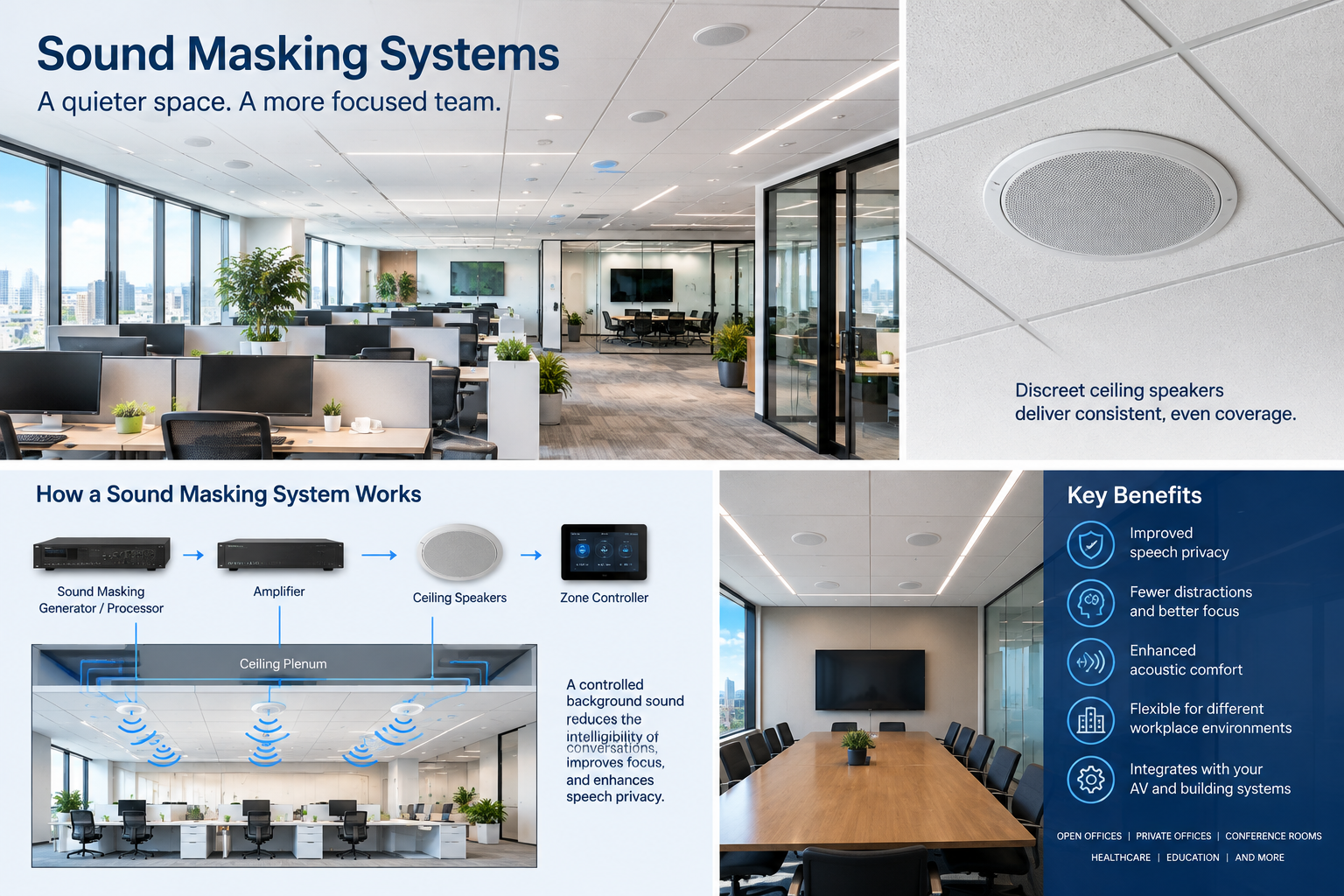
In today’s modern workplace, effective communication, employee productivity, and speech privacy are essential to a successful business environment. While open office layouts encourage collaboration, they can also introduce acoustic challenges, including distracting conversations, unwanted background noise, and a lack of speech confidentiality.
Sound masking systems provide an engineered solution to these challenges by improving the acoustic environment through the controlled distribution of a specially designed background sound. When properly designed and commissioned, sound masking can help reduce speech intelligibility at a distance, improve workplace concentration, and support privacy in offices, conference rooms, healthcare facilities, and other commercial environments.
For organizations investing in workplace technology, sound masking is an important component of a comprehensive acoustic design strategy.
What Is a Sound Masking System?
A sound masking system is an electroacoustic system that introduces a carefully calibrated, unobtrusive background sound into an occupied space. The sound is typically engineered to resemble a soft, consistent airflow rather than music or conventional white noise.
Unlike sound reinforcement systems, which are designed to make speech and other audio content easier to hear, sound masking systems are designed to make conversations less intelligible outside their intended listening area.
Human speech contains a broad range of frequencies, and conversations can travel considerable distances through open spaces, corridors, ceilings, and adjacent rooms. In a quiet environment, even ordinary conversations may become distracting or intelligible to unintended listeners.
Sound masking raises the ambient acoustic level in a controlled manner, reducing the contrast between speech and the surrounding environment. This can make distant conversations less noticeable and more difficult to understand without requiring employees to speak louder.
A properly engineered system typically consists of:
Sound masking generators or digital processors: Produce or manage the masking signal.
Amplifiers: Provide the necessary output power to drive the loudspeakers.
Distributed loudspeakers: Deliver the masking sound throughout the designated areas, often from the ceiling plenum or above the ceiling.
Zone controllers: Allow independent adjustment of masking levels for different rooms or functional areas.
Commissioning and calibration: Establish appropriate sound levels and frequency response for the actual space.
Modern systems may also integrate network-based control, centralized monitoring, and scheduling capabilities, depending on the manufacturer and system architecture.
1. Improved Speech Privacy
One of the primary benefits of sound masking is improved speech privacy.
In offices with low ambient noise, conversations between employees can be heard from nearby workstations, hallways, or adjacent offices. This can be particularly problematic in human resources departments, executive offices, legal offices, financial services environments, and healthcare facilities.
Sound masking reduces the effective signal-to-noise ratio of distant speech, making conversations less intelligible to unintended listeners.
This does not mean that sound masking completely blocks sound or guarantees confidentiality. Rather, it reduces the likelihood that ordinary conversations will be clearly understood outside their intended area.
For organizations handling sensitive information, sound masking can complement physical separation, appropriate room construction, door seals, and other acoustic privacy measures.
2. Reduced Distractions in Open Office Environments
Open office designs offer flexibility and encourage collaboration, but they can also expose employees to frequent conversations, telephone calls, and other sources of intermittent noise.
These distractions can interrupt concentration, particularly during tasks requiring sustained attention, analytical thinking, writing, or detailed computer work.
Sound masking helps establish a more consistent acoustic environment. By reducing the intelligibility and perceived prominence of distant conversations, it can make activity in surrounding work areas less distracting.
Potential applications include:
Open-plan offices and shared workstations
Call centers and customer service departments
Coworking spaces
Administrative offices
Collaborative work areas
Hybrid workplaces with a mixture of assigned and flexible seating
The objective is not to eliminate all workplace sound. It is to reduce the disruptive impact of unwanted speech while maintaining a comfortable environment for normal communication.
3. Enhanced Acoustic Comfort
A very quiet room is not always an acoustically comfortable room. In environments with exceptionally low background noise, small sounds and distant conversations may become unusually noticeable.
Sound masking introduces a consistent, controlled acoustic background that can reduce the perceived contrast between quiet periods and sudden sound events.
This can make the environment feel more uniform and less affected by fluctuations in nearby activity.
However, acoustic comfort depends on proper system design. Excessive sound levels, poor frequency balance, or uneven coverage can create annoyance rather than improve the workplace.
For this reason, sound masking should be professionally calibrated to suit the building, the occupants, and the intended use of each space.
4. Support for Confidential Meetings and Private Offices
Conference rooms, executive offices, consultation rooms, and meeting spaces often require additional attention to speech privacy.
Sound masking can be deployed in surrounding corridors, adjacent work areas, or selected spaces to help reduce the intelligibility of conversations that travel beyond the intended room.
In some applications, localized masking near a room’s perimeter can also form part of a broader privacy strategy.
It is important to distinguish sound masking from sound isolation. Masking does not repair a poorly constructed wall, seal an undercut door, or eliminate sound transmission through shared ceilings and ductwork.
Where confidentiality is critical, a complete acoustic assessment should consider:
Wall construction and sound transmission performance
Door assemblies, seals, and gaps
Ceiling plenums and shared return-air pathways
HVAC penetrations and other flanking paths
Room reverberation and background noise
Masking coverage in adjacent occupied areas
The best results come from combining sound masking with appropriate architectural and mechanical design measures.
5. Greater Flexibility for Modern Office Design
Many commercial buildings use open ceilings, glass partitions, movable walls, and flexible workstation layouts. These architectural features can create acoustic challenges that traditional room-by-room solutions do not fully address.
A zoned sound masking system can be designed to accommodate different workplace functions, including open offices, private offices, circulation areas, and collaboration spaces.
Independent zone control allows acoustic settings to be adjusted for the intended use of each area. For example, a quiet administrative workspace may require a different masking configuration from a busy customer support floor.
When planning a new office or renovating an existing building, incorporating sound masking early in the design process can help coordinate loudspeaker placement, cabling, power requirements, ceiling conditions, and control infrastructure.
6. Integration with Commercial Audio-Visual and Building Systems
Sound masking is a specialized audio application, but its design and deployment share important considerations with commercial audio-visual systems.
Both require an understanding of room geometry, loudspeaker distribution, signal routing, amplification, cabling, control systems, and commissioning.
Depending on the product selected, sound masking may support centralized configuration, network-based management, scheduled operation, or integration with broader building technology workflows.
An experienced AV integrator can help coordinate sound masking with other building systems, including:
Conference room AV and control systems
Distributed audio infrastructure
Structured cabling and network planning
Ceiling coordination and architectural requirements
Facility management and maintenance procedures
Sound masking should generally remain appropriately separated from program audio and paging functions unless the selected system has been specifically designed to support those functions. Masking levels must not compromise speech intelligibility for emergency announcements, paging, or normal face-to-face communication.
7. Potential Benefits for Employee Productivity and Workplace Experience
Workplace acoustics can influence how employees perceive their environment and how easily they maintain concentration.
Reducing distracting conversations may help employees stay focused on complex tasks and improve their overall experience of shared workspaces. A more consistent acoustic environment may also make open offices feel less intrusive.
These benefits depend on the nature of the work, the existing acoustic conditions, the preferences of the occupants, and the quality of the installation.
Sound masking is not a substitute for good workplace planning, adequate quiet rooms, thoughtful office layouts, or effective organizational policies. It is one component of a broader strategy for creating a productive and comfortable workplace.
How Sound Masking Technology Works
Sound masking systems are most effective when the sound is distributed evenly and its acoustic characteristics are appropriate for the space.
Frequency Response
Human speech contains important intelligibility cues across multiple frequency bands. A masking signal must be designed with a suitable frequency response to reduce the intelligibility of speech without sounding harsh, distracting, or unnatural.
Many professional systems provide electronic equalization or digital signal processing to adjust the masking spectrum during commissioning.
Sound Pressure Level
The masking level is measured in decibels, typically using A-weighted sound pressure level (dBA) for overall environmental assessment. Depending on the application, additional measurements may be needed to evaluate frequency-specific performance.
There is no single masking level that is appropriate for every building. The target depends on the existing background noise, ceiling height, room geometry, occupancy, and required privacy.
Too little masking may provide limited benefit. Too much can become annoying, interfere with conversation, or contribute to excessive overall noise.
Loudspeaker Placement and Coverage
Professional sound masking systems commonly use distributed loudspeakers positioned above suspended ceilings or within ceiling systems designed for the application.
Placement and spacing are critical to maintaining uniform coverage. Ceiling construction, plenum dimensions, HVAC equipment, partitions, and other building features can affect sound distribution.
A system that sounds consistent at one workstation may have noticeable variations elsewhere if loudspeaker placement and output levels are not properly designed.
Zoning and Calibration
Different areas of a building often require different acoustic settings. A professional system may divide the facility into independently adjustable zones.
During commissioning, the installer measures and adjusts the sound field to establish appropriate levels and spectral balance across the occupied areas.
Calibration should account for the actual installation rather than relying exclusively on factory settings or theoretical loudspeaker coverage.
Sound Masking Best Practices
For successful deployment, organizations should consider the following recommendations:
Perform an acoustic site survey. Document room dimensions, ceiling construction, occupancy, existing noise levels, and privacy requirements.
Define the desired outcome. Identify whether the primary goal is reducing distractions, improving speech privacy, or addressing a combination of acoustic concerns.
Develop a coverage and zoning plan. Establish loudspeaker locations, zone boundaries, amplifier requirements, and control arrangements.
Coordinate with other building systems. Review lighting, HVAC, fire protection, ceiling access, power, and cabling requirements before installation.
Commission the system in the actual space. Measure sound levels and frequency response, then adjust settings to suit each area.
Evaluate occupant comfort. Gather feedback after implementation and make controlled adjustments where necessary.
Establish maintenance procedures. Document configuration settings, verify operation periodically, and re-evaluate coverage when walls, ceilings, or workstation layouts change.
For projects involving sensitive conversations, privacy expectations should be documented clearly. If formal acoustic performance criteria apply, the design team should identify the relevant standards and testing methods before construction.
Sound Masking Compared with Other Acoustic Solutions
Sound masking works best as part of an integrated acoustic strategy.
| Solution | Primary purpose |
|---|---|
| Sound masking | Reduces the intelligibility and prominence of distant speech |
| Acoustic ceiling tiles | Absorb sound and reduce reflected energy |
| Acoustic wall panels | Reduce reflections and reverberation |
| Sound-isolating partitions | Limit sound transmission between spaces |
| Door seals and perimeter treatments | Reduce leakage through gaps and door assemblies |
| Space planning | Separates noisy activities from concentration-sensitive work |
These solutions address different acoustic problems. For example, acoustic absorption can reduce reverberation within a room, while sound isolation limits the amount of sound passing between rooms. Sound masking addresses how audible and intelligible sound is within the receiving environment.
In many workplaces, the strongest result comes from combining several of these approaches.
Conclusion: A Smarter Approach to Workplace Acoustics
Sound masking is a valuable technology for organizations seeking to improve speech privacy, reduce conversational distractions, and create a more comfortable acoustic environment.
When properly designed, installed, and calibrated, a sound masking system can support open office layouts, private offices, conference areas, healthcare environments, and other commercial spaces where acoustic comfort and speech privacy matter.
The key to success is a system engineered for the specific building and its occupants. Appropriate frequency response, uniform loudspeaker coverage, zoning, commissioning, and coordination with other acoustic measures are essential to achieving the intended results.
Proud Audio-Visual helps organizations plan and implement commercial audio-visual and workplace technology solutions. If you are evaluating sound masking for a new facility, office renovation, or existing workplace, a professional site survey can help identify acoustic challenges, determine coverage requirements, and establish an appropriate system design.
Visit https://www.proudaudio.com/ to learn more about commercial AV solutions and discuss your next project.